
BS EN 1177 · usually a one-day job
Wetpour repairs
Shrunken perimeters, cracked sections and worn swing bays — repaired in place to close trip hazards and restore compliant fall protection.
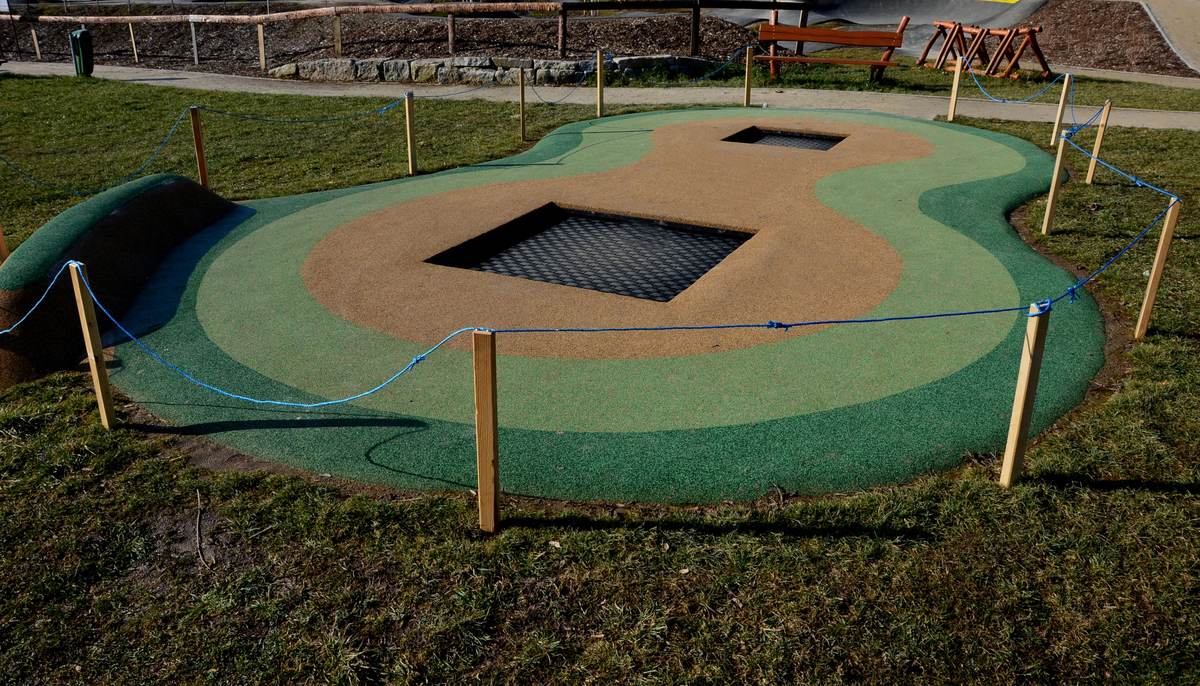
Wetpour is the seamless poured rubber surface found under most modern play equipment. It performs well for a decade or more, but it moves with the seasons — and in Cornwall, with big temperature swings and constant damp, it tends to show its age around the edges first.
The important point: you almost never need to replace the whole surface. Provided the base beneath is sound, localised repairs restore both safety and appearance for a fraction of the cost.
What we repair
Perimeter shrinkage — band repairs
The classic wetpour defect. The surface pulls away from the edging, leaving a gap that catches feet and appears on every inspection report. We cut the shrunken edge back to a sharp line and lay a fresh band between surface and kerb.
Worn bays under swings and slides
High-traffic zones wear thinnest exactly where fall protection matters most. We cut out the worn section and re-lay to the correct depth for the equipment's free height of fall.
Cracks and splits
Cracks let water into the base and Cornish freeze-thaw widens them. Cut out and re-laid early, it stays a small job; ignored, it becomes a base failure and a full replacement.
Overlays
Where wear is widespread but the base is sound, a bonded overlay lays a fresh wear layer across the existing surface — restoring depth, colour and compliance without excavation.
Why depth matters
Every piece of play equipment has a free height of fall, and the surfacing beneath it must be rated to at least that height under BS EN 1177. That rating depends on the depth and specification of the surface — so as wetpour wears, thins or compacts, the protection it provides falls with it.
The exact critical fall height varies between products and depths, and is set by each material's own test certificate rather than a rule of thumb. We work to the certificate for the material actually being laid, and record it in the paperwork so it stands up at your next inspection.
That's the real reason to fix worn surfacing: not because it looks tired, but because a site with degraded fall protection has quietly stopped complying.
Not sure whether yours needs a repair, an overlay or replacing? Send a few photos and we will tell you honestly — including when the answer is "leave it another season". See also rubber mulch and resin bound and all safety surfacing.
Questions
Frequently asked
What is a band repair?
Where wetpour has shrunk away from the edging, we cut the shrunken edge back to a clean, sharp line and lay a fresh band of wetpour between the existing surface and the kerb. It closes the gap, removes the trip hazard and restores the surface to the edging — without touching the rest of the playground.
Why has our wetpour shrunk?
It is normal behaviour, not a fault. Wetpour expands and contracts with temperature and moisture, and over years of British weather it gradually pulls in from the perimeter. Coastal Cornwall sites, with big temperature swings and constant damp, tend to show it sooner.
Will the repair match the existing colour?
As closely as the material allows — but the existing surface will have faded with UV, so an exact match is rarely achievable. Many clients choose a deliberate contrasting band, which reads as a design feature rather than a patch.
How long before children can use it?
Wetpour needs dry conditions to lay and typically 24 hours to cure before use. We schedule around the weather and, for schools and holiday parks, around your opening times so the area is back in service when you need it.